


Sleeping with One Eye Open
Sleeping With One Eye Open

Sleeping with One Eye Open
Susan Fusco-Fazio
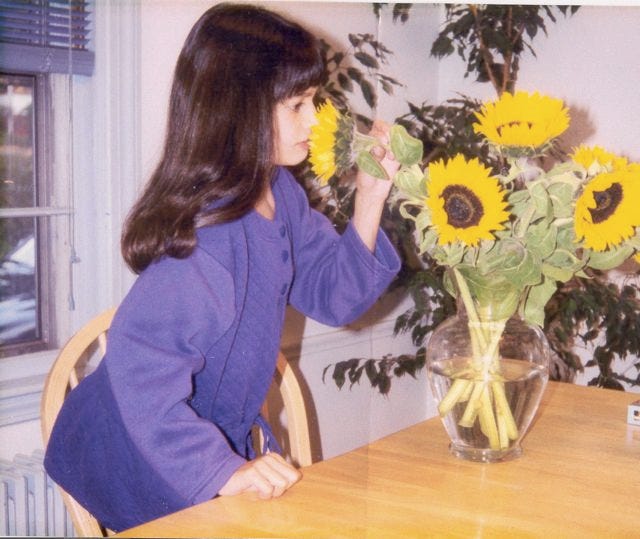
Laura was beautiful. She had long dark brown hair that glowed in sunlight and shade. Her warm brown eyes were soft yet penetrating. Her skin complexion was classic Italian, an olive tone. Laura had a wide toothy smile that lit up a room. She was always small for her age and very thin. The doctors said it was because her heart was always working hard. As Laura grew into her pre-teen years she became even thinner, wiry thin. The clock was ticking. Paul and I both felt this in the gut.
The doctor’s predictions were coming true. When Laura was 3 years old, the heart surgeon placed a Bi-Directional Glenn Shunt into Laura’s heart to help her heart pump more red blood than blue blood, so that she could thrive and grow. After the surgery, her surgeon said that, eventually as Laura grows taller, the shunt will no longer work effectively to help the heart pump blood to her organs. When that happens, she will need more heart surgery. This is how we knew the clock was beginning to tick. Laura became thinner despite her good appetite, painfully thin. The cardiologists ordered tests, including a catheterization procedure, revealing that Laura’s heart was working harder, burning away many of the calories she ate. The surgeon said we had one or maybe two years before another corrective open heart surgery was imperative. The doctors plan was to follow Laura closely every month with examinations and tests. They would let us know when time was up, when we needed to venture forward into more uncharted waters.
Laura was unaware of the ticking clock, or was she? We often wondered if she felt it too. Laura knew there would be more heart surgeries, but she did not appear to be actively thinking about it. Laura was busy living her life; going to school, being creative, writing stories, playing with her friends, visiting family, taking singing and acting lessons. According to Laura, life was good as long as she stayed out of the hospital as she put it. Paul and I followed the doctors plan and Laura’s lead. Paul and I chose not to over focus on the direness of Laura’s condition. When we did, we felt intense fear and emotional pain.
We took our cues from Laura. Paul and I developed this motto as a way of coping with the unpredictability of parenting a medically complex and vulnerable child since the time Laura was a baby. If Laura was happy, we were happy. If we weren't sure things were OK, but Laura seemed OK, we calmed down and allowed ourselves to feel OK too. If Laura was lethargic or showed signs of distress, we became worried and called the cardiologist. Laura was our compass, and the hospital was our life boat. When at home and not in the hospital, we lived with daily assessment of Laura’s health. Since the early years of our initiation into parenting a cardiac baby, our instincts became finely tuned. If something was wrong, an inner alarm went off, like an involuntary reflex, by Laura’s pre-teen years. We lived in a parallel universe; one in which we went about our day to day life, carefully monitoring and parenting a daughter with Congenital Heart Disease (CHD), while pretending life was normal. We became adept at de-focusing on the negative realities of our life until we were forced into it. Mainly, we lived happily in the present moment. We tried not to think about the future, but when we did it was to plan fun adventures, like three sunflowers facing the sun. Hoping for the best, we lived in a state of happy denial most of the time. Living in medical limbo, denial served us well.
We chose normal, when life was not. We wanted Laura to have a “normal life”, so we created one together. It felt normal for us, since this was our parenting experience, life with our first and only child. There were no distractions, no diversions, no healthy siblings bopping around to compare Laura to. When things were good, we saw Laura as a well child. One day Laura asked me if she was always sick. I told her that SHE wasn’t sick, but her HEART was. We tried not to define Laura by her heart condition, nor did we overly identify her this way or advertise it. Laura lived every day of her life in degrees of congestive heart failure, on several medications, with safeguards, and precautions put in place everywhere she went. But as far as we were concerned, Laura was perfect. This worked for us, feeling life was normal even though we knew it wasn’t.
Laura was born with one of the most serious and complicated of heart conditions. She had a heart with three chambers instead of four. Laura was essentially missing the right ventricle since it was non functional. She also had a host of other complications, one being transposition of the great arteries, in which the aorta and pulmonary arteries are in switched positions. This rare and life threatening condition is known as Hypoplastic Right Heart Syndrome, a form of Complex Congenital Heart Disease. When we were asked or when it became necessary to inform others people, we chose to say Laura has a heart condition.
Paul and I were regularly snapped out of living in denial. We were reminded of Laura’s heart condition every morning and evening when crushing her heart meds into ice cream or yogurt so she could tolerate it, or when we wrote letters to the school or briefed parents for playdates. We were reminded of our plight at the regular clinic appointments at Children’s Hospital, where we spent the days supporting Laura through a host of medical tests that she became used to, except for the ones that hurt, the blood tests. During clinic visits, Laura endured frequent lung x-rays, echocardiograms and EKGs, culminating in a physical examination with her cardiologist, Dr. Mary. Sometimes Laura was sent home with a 24 hour Holter Monitor to check on her heart arrhythmias. This reality of Laura with all her medical needs and vulnerabilities would slap us in the face and shake us awake, often leading us back to the dark side of worry. If we got a good check up we celebrated and went out to dinner in Boston. If we heard bad news, we stuffed it down and still went out to dinner, so as to not let Laura see us upset.
Repeatedly, we bucked back up, tried to take it in stride, and went about our daily lives; school, work, family and social commitments. Other people took their cues from us, much in the way we took our cues from Laura. If friends, family, teachers and co-workers saw that we were relaxed, they did not worry. If we seemed out of sorts or upset, they worried with us and for us. Paul and I kept our darkest feelings inside, sharing only with a few close confidants. We put on a good show, but we were often secretly scared to death. In our private moments in the night when the world was quiet, we shared our fears and tears with each other, and endured many sleepless nights of worry. We always returned to pretending normal, making Laura’s life as happy as we could. The bottom line; every day we had together was a day worth celebrating, a true blessing.
Each night when Laura slept at home in her bed, I checked on her to make sure she was still breathing. When I went down for a night's rest, I would wake up often to check on her. I slept in a state of half awake and half asleep. Any sound at all coming from Laura’s room would wake me up, a cough or even a sigh. I read that dolphins sleep in a half-sleep state, called "sleeping with one eye open." One side of their brain stays awake and the opposite eye stays open to watch for danger and rise to the surface to breathe. Meanwhile, the other half of the brain sleeps and the opposite eye is closed. After about two hours, the sides switch so the entire brain gets rest. It was a good thing that I slept like a dolphin. There were times that I needed to call an ambulance in the middle of the night to get Laura right to the hospital. This part of Laura’s life did not fall into feeling good, pretending everything was normal.
I felt like a soldier, always on alert, looking out for the enemy. In my case the enemy was a cardiac incident. I was ever ready to spring into service, to save my daughter’s life. When times were good and things were calm, this soldier would chat it up, laugh with Laura, Paul and the rest of the civilians like everything was fine, but I was still on duty. When real duty called, I was the first one up and to the rescue, even though I was chilled to the bone with fear. I did what was needed. On one such night, I was sleeping in our bed when I heard the faintest sound coming from Laura’s room, a weak whisper voice beckoning to me, “Mommy….Mommy…”.
I was shaken awake with a jolt. Action took me over like a supernatural force. I ran into Laura’s room and went right into medical assessment mode. Laura struggled to tell me what she was feeling, “ I’m out of breath, my heart is pounding, I feel dizzy…. and nauseous.”
I comforted Laura. I looked for nasal flaring, a sign of breathing trouble. I was sure that I saw this. I knelt onto the floor and leaned over Laura, placing my ear on her chest to listen to her heart. Was it too fast? Too slow? Irregular? It was hard to hear. I grabbed the stethoscope I kept on the dresser and strained to listen. While looking at the digital clock, I attempted to count Laura’s heart rate per minute. I couldn't count it properly. Laura’s heart sounded all jumbled, fast and irregular, like a traffic jam. I got up and ran back to our bedroom to wake up Paul. He sprang into action, ran into Laura’s room, as I called for help. I had to make a decision. Page the cardiologist? Call 911? Sometimes I called 911 first, other times the cardiologist. I had to use my instincts. I decided to call the page operator at Children’s Hospital. Seconds later Dr. Mary was on the line. I reported Laura’s symptoms and she agreed that I should call an ambulance, telling me she would meet us at the hospital. Dr. Mary was there for us, no matter what time of day or night. Mary was our life line, our savior in the storms. We were in this together, and we were ever grateful for a doctor we could lean on for direction and support when we were at home, when danger reared its ugly head. I called 911. Within minutes the medics arrived, and our scared sick daughter was on route in an ambulance to the hospital to endure God knows what. Following behind the ambulance in our own car, Paul and I got ready to face the unknown. Laura’s heart condition was now front and center again. Prayers, trust and faith were summoned. Reality kicked at us. We were hit on our heads with full force. There was no denying that we were parenting a very sick child.
Once at the hospital, Laura was transported immediately from the ER to the Cardiac Intensive care unit. There was no wait time. Laura was treated for Atrial Fibrillation and dehydration, and evaluated by Dr. Welch, her rhythm doctor. It was determined that Laura’s heart rate dropped very low in the night and then triggered the fast heart rate event. After a few days in the hospital Laura was sent home with the 24 hour holter monitor to evaluate her heart rhythms. As time went on, we were faced with this debacle again and again, sometimes during the day, but mostly in the middle of night. One time it happened when Laura had a best friend over for a sleep over, other times it occurred during the day or when we were traveling. Eventually, the cardiac team felt it necessary to implant a pacemaker into Laura. The decision was not taken lightly by the cardiac team. Pacemaker surgery is usually a fairly routine procedure, but was far more serious for Laura. She had been the complication patient at every turn; beginning with a misdiagnosis and late diagnosis during infancy. Laura was prone to side effects from surgeries and procedures, and was known to have notoriously long recovery times in the hospital.
The pacemaker was put in when Laura was in the fourth grade. Our nights were a bit calmer and Laura’s school days felt a bit safer. Laura managed to not become an overnight patient in the hospital for one whole year. This was a record for Laura. She wrote about it in her diary and would often declare that 1998 was her best year, the year she stayed out of the hospital. While Laura celebrated her reprieve, Paul and I knew that this would be short lived. The pacemaker surgery only solved the rhythm problem but not the bigger problem. The clock was still ticking for the pending major open heart surgery. The doctors would let us know when it was time. We tried not to think about it. So once again, we took our cues from Laura. She was like a sunflower, always facing the sun, our leader and guide on to how to live a happy life.
To read article: Dolphins Sleep Half a Brain at Time, Click on link below
https://animals.howstuffworks.com/mammals/dolphins-sleep-half-brain-at-time.htm
Hi Susan. Thank you for this beautiful essay, bravely sharing the raw details and beautiful spirit of Laura. You're the first person, I've read, who's managed to capture the long, never-ending hypervigilance: the starts, slaps, sleeping with one eye open with both ears straining and the 0 to 100mph adrenalin rush in under 10 seconds. Normalising the new norm, constantly adapting, readapting, appreciating, trying to feel blessed before the next shoe drops at around midnight...
I know all of these things with intimate clarity.
My experience is very different but also, in many caregiving ways, the same.
Thank you for eloquently sharing the realities of caring in such detail. Even after 4 years, the flinch moments of thumps, bumps, shouts and falls on stairs can be too acute to express.
Thank you for this reminder: “The bottom line; every day we had together was a day worth celebrating, a true blessing.” I love the sunflower 🌻 metaphor. Your writing flows so well.